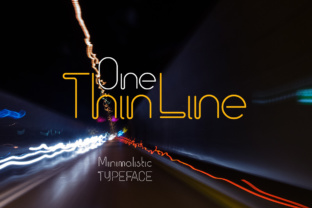
One Thin Line: A Minimalist Font Built on Simplicity
Minimalist design continues to shape how we communicate visually, and typography sits at the center of that shift. Among the growing collection of clean, stripped-down typefaces, One Thin Line stands out for its strict adherence to a single design principle: every letterform and character is drawn from one continuous line. That constraint is not a limitation but a deliberate choice that gives the font its character, utility, and distinct visual voice. This article examines what One Thin Line offers, where it works best, and whether it deserves a place in your project toolkit.
What Makes One Thin Line Distinct
One Thin Line is not trying to be a workhorse text face for long paragraphs or dense documentation. It is a display-oriented, decorative typeface built around an extreme reduction of form. Every glyph — from uppercase and lowercase letters to numerals and common punctuation — is constructed using a single, unbroken stroke of uniform thickness. There are no varying weights, no serifs, no ornamental flourishes. The result is a font that reads as both modern and elemental, like a wireframe sketch rendered with deliberate precision.
Its consistent stroke width and minimalistic structure give it a clean, airy appearance. This makes it especially effective at large sizes where the negative space inside each letter becomes part of the design. The letters feel almost architectural, as if drawn by a single pass of a pen that never lifts from the page. That visual gimmick — if you can call it that — is also its defining strength: it communicates clarity, openness, and a sense of handcrafted restraint.
Key Characteristics and Design Philosophy
Understanding what One Thin Line does well starts with understanding what it deliberately avoids. The font does not attempt to mimic traditional typography conventions. There are no thick-thin contrasts, no bracketed serifs, no optical adjustments for readability at small point sizes. Instead, it leans fully into its concept.
- Uniform stroke weight: Every character uses the same line thickness, which creates a consistent visual rhythm across words and phrases.
- Geometric simplicity: Curves are smooth and purposeful. Sharp corners are minimal, and no stroke is wasted on decoration.
- Continuous construction: Each letter is drawn without breaks. This gives the font a signature look that is immediately recognizable.
- Limited character set but intentional: While it may not include every diacritic or special symbol found in more comprehensive type families, the core set covers standard English text, numbers, and common punctuation.
These traits make One Thin Line a font that communicates best when used sparingly and with purpose. It is not a font that disappears into the background. It demands attention, but it does so quietly — through structure rather than ornament.
Practical Value in Real-World Design Work
For professionals who work with visual communication — whether in branding, editorial layout, web design, or presentation materials — One Thin Line offers a specific kind of utility. Its strength lies not in versatility across every use case but in providing a distinctive option for projects that benefit from a clean, uncluttered aesthetic.
Consider a brand identity for a creative consultancy or a design studio. A wordmark set in One Thin Line conveys openness, precision, and a willingness to work with less. It signals that the brand values clarity over complexity. Similarly, in event posters, book covers, or editorial headers, the font works well when paired with more traditional typefaces. It can serve as a headline or accent face that draws the eye without overwhelming the page.
One of the font’s most practical applications is in digital interfaces where minimalism is a core part of the user experience. Splash screens, navigation titles, or section dividers in a clean web layout can benefit from the airy feel of One Thin Line. It also appears frequently in logo design, especially for brands in fashion, beauty, hospitality, and technology — industries where simplicity is often equated with sophistication.
For creators working on presentations, the font can bring a cohesive, modern look to slide titles and section headers. It pairs well with sans-serif body fonts like Open Sans, Lato, or Inter, where its delicate structure provides contrast without clashing.
Strengths in Context
One Thin Line performs best when given space. At large point sizes — 48px and above — the characters read clearly and the single-line construction becomes a visual asset. The negative space inside an uppercase “O” or “D” takes on as much importance as the line itself, creating a balanced, almost sculptural effect. On dark backgrounds, the font can be particularly striking, especially when used in white or a light accent color.
Its consistency is another strength. Because every character follows the same stroke logic, words set in One Thin Line have a uniform rhythm that feels orderly and intentional. There are no surprises in glyph widths or unexpected curves. Once you understand the system behind the font, you can predict how any word or phrase will look.
Reliability in presentation is also worth noting. The font renders cleanly on screen at appropriate sizes, and its simple structure means it generally translates well across different platforms and rendering engines. Given that it lacks complex shapes or fine details, it holds up on both retina displays and standard resolution screens without noticeable degradation.
Limitations to Consider
No typeface is universal, and One Thin Line comes with real constraints that designers should evaluate honestly before committing to it.
- Readability at small sizes: Below 24–30px, the thin stroke can become difficult to read, especially on screens with lower pixel density. In body text or small captions, the letters may appear fragile or indistinct.
- Limited character coverage: If your project requires extended language support, mathematical symbols, or specialized glyphs, One Thin Line may not be sufficient as a standalone typeface.
- Conceptual repetition: Because the font is built around a single idea, using it across multiple contexts in the same project can feel repetitive. It works best as a deliberate accent, not a primary text face.
- Overuse risk: The font’s minimalism can be striking in small doses, but large blocks of text set in One Thin Line lose impact quickly. It is designed for impact, not endurance.
- Accessibility concerns: For users with visual impairments or reading difficulties, the uniform thin stroke may not provide enough contrast or letter distinction for comfortable reading. Always test the font in context before finalizing a design.
These limitations do not make One Thin Line a poor choice. They simply clarify where it belongs and where it does not. Professionals who understand these boundaries will find it far more useful than those who expect it to perform like a general-purpose typeface.
Who Benefits Most from One Thin Line
Understanding the audience for this font is essential for making an informed decision. One Thin Line is not aimed at every designer or every project. It is a specialized tool for specific situations.
Graphic designers working on branding and identity projects will find it useful when a clean, minimal look is part of the brief. It works especially well for logos, monograms, and wordmarks that need to feel modern and uncluttered. Freelance designers who take on boutique or lifestyle brand projects often reach for One Thin Line when they need a font that communicates elegance without being ornate.
Marketers and small business owners creating their own visual materials may also appreciate the font. If you are building a website or presentation for a service-based business — coaching, consulting, creative direction, wellness — the clean lines of One Thin Line can help communicate professionalism and clarity. It is also a solid choice for social media graphics where text needs to be legible at a glance but also visually interesting.
Publishers and bloggers working in design, fashion, or lifestyle niches can use One Thin Line for headers, pull quotes, or cover titles. It pairs naturally with editorial photography and generous white space. Educators and course creators might use it sparingly in slide decks or course landing pages where the goal is to create an immediate visual impression.
Serious hobbyists — whether in calligraphy, digital art, or print design — will appreciate the font’s conceptual purity. It is a typeface that rewards a deliberate hand and a thoughtful layout. Using it well requires understanding when to let it lead and when to let it support.
Practical Recommendations for Use
If you decide that One Thin Line fits your project, using it effectively comes down to context, scale, and restraint.
- Use it at large sizes where the single-line construction is visible and meaningful. 48px or larger is a good starting point.
- Pair it with a readable sans-serif or serif body font that provides visual contrast. The lighter the headline, the more grounded the body should feel.
- Limit its use to short phrases, single words, or initials. Do not attempt to set paragraphs or detailed instructions in this font.
- Test readability on the actual medium where the font will appear — whether that is a website, a printed piece, or a presentation screen.
- Consider using letter-spacing adjustments. Depending on the context, slight tracking can improve legibility and enhance the airy feel.
- Always check color contrast. The thin stroke means that light colors on light backgrounds may disappear.
These recommendations are not rules, but they come from seeing how the font behaves in real projects. Following them will save time and prevent design choices that feel forced or ineffective.
Long-Term Value and Versatility
One Thin Line is not a font you will use every day, and it should not be. Its value is situational. But for designers and creators who maintain a curated type library, it earns its place as a reliable option for minimal, clean, and visually open layouts. It holds up well over time because true minimalism rarely dates. The font does not rely on trends or gimmicks — it relies on structure and restraint.
Where it falls short is in broad versatility. If you need a typeface that can move from headings to body text, from web to print, and from formal to playful without missing a beat, One Thin Line is not that font. It is a specialist, not a generalist. That distinction matters when building a long-term toolkit. The best font collections include both workhorses and specialists. One Thin Line belongs in the second category.
Evaluating it honestly means recognizing that its greatest strength — its strict minimalism — is also its most significant constraint. That is not a flaw. It is a design decision. And for the right project, it is exactly what makes One Thin Line worth choosing.