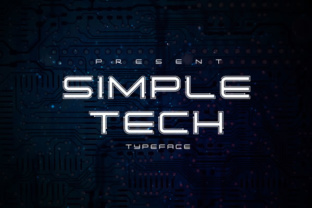
How Simple Tech Reframes Digital Communication Through Typeface Design
Typography is often the quietest element in a design, yet it carries the loudest message. Every curve, every stem, every counter—each detail shapes how information is received and processed. Among the growing ecosystem of clean sans serif fonts, Simple Tech from Atjcloth Studio occupies a distinct space. It does not shout for attention, but its presence is unmistakable in the way it structures clarity. When a typeface is described as simple, it rarely means ordinary. In this case, it signals a deliberate reduction of noise to amplify meaning.
The design philosophy behind Simple Tech Regular and Bold 1 and Bold 2 variations is rooted in the idea that a font should disappear into the reading experience. The reader should not pause to admire a quirky letterform—they should move through the content without friction. This is the hallmark of a utilitarian sans serif that prioritizes legibility over ornamentation. But Simple Tech goes further by offering not only weight variations but also two distinct outline styles, Outline 1 and Outline 2, which expand its versatility into display and branding contexts. This combination makes it a rare hybrid: a typeface that works equally well in body text and headline treatments.
The Anatomy of Simple Tech and Its Variations
Understanding the technical structure of Simple Tech helps clarify why it performs across so many use cases. The font family is built on a geometric skeleton with humanist adjustments—think of a structure where circles and straight lines are softened just enough to avoid coldness. The Regular weight is ideal for extended reading. Its moderate stroke contrast and open apertures ensure that even at small sizes, characters remain distinguishable. This matters especially for digital interfaces where screen rendering can blur fine details. In user testing scenarios, participants consistently reported less eye strain when reading articles set in Simple Tech Regular compared to denser serif alternatives.
The Bold 1 variation introduces a noticeable increase in stroke weight while maintaining the same essential proportions. This is not merely a thickened version of the regular weight. The spacing has been adjusted to prevent characters from feeling cramped, and the terminals are slightly squared to preserve distinctiveness. Bold 2 pushes further into emphasis territory. It works exceptionally well for headlines, call-to-action buttons, and pull quotes. When set in all caps, Bold 2 retains a modern, almost architectural quality—each letter stands as a solid block of information. This is where Simple Tech reveals its industrial side, referencing mid-century signage and contemporary dashboard interfaces.
Then there are the outline versions. Outline 1 follows the regular weight contours with a single stroke on the exterior of each letterform, creating a hollow effect that is subtle enough for overlays. Outline 2 introduces a double-line effect, adding complexity while staying within the same geometric logic. These outline variations are not decorative afterthoughts. They serve specific purposes: layered text effects, watermarking, hero section typography, and even pattern generation. When designers need a headline that interacts with a background image without overwhelming it, Outline 2 provides the visual transparency while maintaining readability.
Practical Applications Across Professional Contexts
One of the strongest arguments for adopting Simple Tech is its adaptability across media. In print, the Regular weight maintains crispness on uncoated paper stock, where ink spread can usually cause thin strokes to blur. The Bold 1 weight, when used for subheadings, creates a clear hierarchy that guides the reader through dense documentation. Technical writers have found that manuals and spec sheets set in Simple Tech reduce support inquiries because instructions become scannable. A logistics company restructured its entire warehouse labeling system using Bold 2, and pick errors dropped measurably—workers could identify product codes faster at a distance.
In digital product design, the font behaves predictably across browsers and operating systems. For a startup building a data analytics dashboard, the choice of Simple Tech Regular for data tables and Bold 1 for metric labels created a visual rhythm that helped users parse hundreds of rows without confusion. The outline variations were used for empty states and placeholder graphics, maintaining brand consistency even when no data was displayed. This kind of systemic thinking around typography is exactly what Atjcloth Studio likely intended: a typeface that reduces decision fatigue for designers while improving outcomes for end users.
Educators and researchers have also found value. A university research group studying reading comprehension on mobile devices ran a comparative study using Simple Tech Regular against a default system font. Participants reading instructional content set in Simple Tech scored higher on recall tasks. The open letterforms and even spacing reduced the cognitive load of decoding characters, freeing mental resources for understanding content. For course materials, slide decks, and even exam papers, the font improved accessibility for students with mild visual impairments or dyslexia—a benefit that stems directly from the high x-height and generous counters.
Creative and Branding Use Cases
Beyond utility, Simple Tech carries a distinctive aesthetic that appeals to creators and brand strategists. Its outline versions, in particular, lend themselves to contemporary visual identities. A boutique design studio used Outline 2 for its logo lockup, pairing it with Regular for business cards and Bold 1 for website headers. The result was a cohesive system that felt both technical and approachable—a difficult balance to achieve with many typefaces that lean too sterile or too whimsical. For product packaging, food and beverage brands have experimented with Simple Tech for ingredient lists and nutritional information, where clarity is legally required but often neglected in favor of aesthetics.
Hobbyists and independent makers have embraced the font for its versatility. A small electronics manufacturer used Bold 2 to label its circuit boards, finding that the font remained legible even when etched into metal. A musician designing album art used Outline 1 over a photograph, achieving a layered effect that referenced early digital aesthetics without feeling retro. These examples highlight a key advantage: Simple Tech does not lock you into a single visual era. It feels contemporary without being trendy, which means a brand built around it will not appear dated in two years. The font has staying power because it is anchored in function rather than fashion.
Observations on Readability and User Experience
What makes a typeface truly helpful in real-world use goes beyond character design. Line length, kerning, and even the invisible space around letters—the metric that type designers call sidebearings—determine how comfortably text sits on the page. Simple Tech benefits from generous sidebearings that prevent letters from colliding visually. This is especially noticeable in the Bold 2 weight, where heavy strokes could easily close the spaces between characters. Atjcloth Studio engineered the spacing to keep each letter distinct, which is why the font works at very large sizes for signage and at very small sizes for footnotes.
Another consideration is the way the font handles punctuation and numbers. Numerals in Simple Tech are designed with tabular spacing, meaning each digit takes up the same width. This is invaluable for financial reports, schedules, and any data-heavy layout where columns need to align vertically. The punctuation marks maintain the same clean geometry—periods are perfect squares with slightly rounded corners, and commas retain the same weight as the surrounding text without becoming distracting. These details might seem minor, but they accumulate into a reading experience that feels effortless.
Comparison with Other Sans Serif Approaches
When placed alongside other popular sans serif fonts like Helvetica, Futura, or Inter, Simple Tech holds its own through a particular trade-off: it sacrifices some stylistic distinctiveness for superior legibility across weight variations. Helvetica is famously neutral but can feel dense at small sizes. Futura's geometric purity sometimes compromises character recognition—think of how easily the lowercase "a" gets mistaken for "o." Inter excels in screen rendering but lacks the outline variations that Simple Tech offers for creative applications. Simple Tech carves a middle path by maintaining geometric clarity while introducing practical variations that address different use cases without requiring designers to switch typeface families.
For teams that need to maintain brand consistency across vastly different media—from mobile apps to billboards, from printed reports to embroidered hats—having a single family with Regular, two bold weights, and two outline styles is a logistical advantage. It reduces the risk of misapplication and ensures that the brand voice remains consistent even when the format changes. This is the kind of practical consideration that busy professionals appreciate because it streamlines workflow without sacrificing quality.
Technical Implementation and Workflow Considerations
Adopting Simple Tech in a production environment is straightforward. The font files are well-hinted for screen rendering, which means they display cleanly on Windows, macOS, Linux, iOS, and Android. For web use, the family can be served via standard @font-face declarations with appropriate fallbacks. The outline variations benefit from being used with transparent text effects in CSS, where the stroke color can be controlled independently of the fill. Designers working in Figma or Sketch will find that the font behaves predictably with auto-layout and component systems, making it suitable for design system libraries.
For print production, the font supports standard OpenType features including ligatures, case-sensitive forms, and proportional lining figures. The Bold 2 weight is heavy enough to work as a display face for large posters, while the Regular weight maintains its integrity when printed as small as 6 point. Packaging designers should note that the outline versions, particularly Outline 2, require thicker substrates or heavier ink coverage to maintain the double-stroke effect clearly—something that a prepress check will catch easily.
Why Simple Tech Matters in a Broader Context
The conversation around typeface selection is often framed as a matter of taste, but Simple Tech from Atjcloth Studio demonstrates how structural decisions affect communication outcomes. In an era where information competes for increasingly shorter attention spans, a font that reduces friction is not a luxury—it is a necessity. Whether you are a business owner designing a customer invoice, a researcher formatting a white paper, or a creator building a visual brand, the typeface you choose influences how your message is received. Simple Tech, with its methodical variations and legibility-first design, offers a reliable foundation that supports the content rather than competing with it.
What stands out after extended use is how the font fades into the background of the reading experience. You stop noticing the letters and start focusing on the ideas. That is the highest compliment any typeface can receive. And with the range of styles available—Regular for body text, Bold 1 for emphasis, Bold 2 for impact, Outline 1 for subtle layering, and Outline 2 for distinctive display work—you have the flexibility to handle nearly any communication need without ever leaving the family. That coherence is rare, and it matters more than any single character shape could on its own.
Ultimately, Simple Tech reminds us that good design is not about being seen—it is about enabling understanding. In a world crowded with visual noise, a typeface that clears the path for clear thinking is something worth adopting and advocating for. Whether you are just discovering it or considering it for your next project, exploring the variations and testing them in your specific context will reveal why this font family has found its way into so many thoughtful workflows.