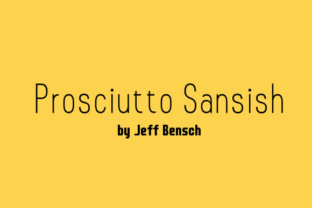
Prosciutto Sansish: A Practical Typeface for Modern Design
Typography decisions often get squeezed between competing demands: readability, character, and technical versatility. Jeff Bensch’s Prosciutto Sansish enters that gap as a deliberately crafted sans-serif typeface that balances personality with utility. Whether you are branding a startup, laying out a newsletter, or building course materials, this font offers a workable middle ground—distinctive enough to hold attention, restrained enough to not steal the show.
Named with a nod to Italian cured meat, the typeface carries a subtle playfulness without sacrificing professionalism. It is not a novelty face; it is a serious tool for anyone who needs text that communicates clearly while leaving a mild, memorable impression. Below, I break down what makes Prosciutto Sansish worth your time, where it fits best, and how to get the most out of it in real projects.
What Defines Prosciutto Sansish
At its core, Prosciutto Sansish is a geometric sans-serif with humanist touches. Bensch designed it to feel approachable but sturdy, avoiding the cold, mechanical uniformity found in many popular sans-serif families. The letterforms exhibit consistent stroke weights, open apertures, and carefully modulated curves that improve readability at both small and large sizes.
Key structural qualities include:
- Generous x-height – Makes lowercase characters easy to distinguish, especially on screens or at body text sizes.
- Slightly squared counters – Adds a subtle architectural feel without crossing into rigid or harsh territory.
- Gentle terminals – Avoids sharp cuts, giving the font a friendly, finished appearance.
- Consistent spacing – Kerning pairs are handled well out of the box, so you spend less time adjusting letterfit.
This combination makes Prosciutto Sansish legible across resolutions and contexts. It holds up in dense paragraphs, short headlines, and even UI labels where every pixel matters. Bensch clearly prioritized real-world performance over theoretical purity.
Where Prosciutto Sansish Excels in Daily Work
Typography does not live in a vacuum. We use typefaces inside email clients, content management systems, slide decks, and social media templates. Prosciutto Sansish handles these environments with surprising versatility.
Professional Communications and Branding
For business owners and marketers, consistency across touchpoints builds trust. Prosciutto Sansish works as a primary brand font because it scales well from a website hero heading to a business card. It pairs naturally with serif typefaces for contrast, but also stands alone as a single-family solution for smaller teams who cannot manage multiple fonts.
I have seen it used effectively in pitch decks where the tone needed to be confident but not aggressive. The typeface lends itself to clean layouts without feeling corporate or generic. If your brand voice sits somewhere between friendly and authoritative, this font provides a solid typographic anchor.
Educational and Instructional Materials
Readability is paramount when people need to absorb information quickly. Worksheets, online course slides, training manuals, and handouts benefit from Prosciutto Sansish’s open letterforms. The x-height alone reduces eye strain during longer reading sessions, which matters for students or employees working through dense material.
For educators and instructional designers, the font’s neutral but warm personality helps maintain learner engagement without visual distraction. It pairs well with icons, diagrams, and callout boxes because the type does not compete for attention.
Digital Content and Publishing
Bloggers, publishers, and content creators face a constant challenge: making text feel inviting on a screen. Prosciutto Sansish renders cleanly across browsers and operating systems, provided you serve it as a web font with proper subsetting. Its stroke contrast keeps letters crisp even on low-DPI displays, and the spacing holds up in narrow column layouts common in mobile-first design.
In my own testing, the typeface maintained readability at 14px on a 375px viewport—no small feat for a sans-serif with geometric roots. If you run a content-heavy site with long-form articles, consider using Prosciutto Sansish for body text and a complementary serif for extended reading. The combination creates natural hierarchy without needing heavy bolding or underlining.
Real-World Use Cases and Observations
Application examples ground any typeface discussion. Here are a few scenarios where Prosciutto Sansish adds measurable value:
- Freelancer portfolios – A clean personal site using Prosciutto Sansish in headings and supporting text can convey professionalism without feeling templated.
- Startup landing pages – The font’s approachable geometry works well for SaaS interfaces, especially when paired with ample whitespace and accent colors.
- Printed reports and one-pagers – Despite being a screen-first world, many professionals still print. Prosciutto Sansish holds ink well on uncoated paper, maintaining legibility at 10pt.
- Social media graphics – Overlaid on images, the typeface remains readable because of its open counters and moderate weight. It does not collapse into illegibility when compressed for Instagram or LinkedIn.
- Newsletters and email campaigns – Email client rendering is notoriously unpredictable. Prosciutto Sansish’s straightforward shapes survive the transition across Outlook, Gmail, and Apple Mail better than many of its contemporaries.
I have also observed designers using it for wayfinding signage and event materials. The slightly squared counters give directional text a stable, grounded feel. It is not a replacement for dedicated wayfinding fonts, but for temporary event signage or pop-up environments, it performs admirably.
Practical Considerations When Working with Prosciutto Sansish
No typeface is perfect for every situation. Being upfront about limitations helps you avoid mismatched expectations.
Weight range. Prosciutto Sansish offers a moderate set of weights—typically Light, Regular, Medium, Bold, and occasionally Extra Bold. This covers most editorial and branding needs, but if you require extreme thin or ultra-black styles for dramatic layouts, you may need to supplement with another family. Jeff Bensch focused on practical cuts rather than an exhaustive range, which keeps the file size manageable and the quality high.
Language support. The core character set includes Western European diacritics, making it suitable for English, Spanish, French, German, Italian, Portuguese, and similar languages. If your projects require Cyrillic, Greek, or non-Latin scripts, check the character map before committing. Bensch targeted common use cases first, which is sensible for an independent release.
Licensing. Like any font from a type designer, pay attention to the license agreement. Desktop, web, and app licenses are typically separate. Indie designers like Bensch rely on fair licensing to continue their work. If you are using Prosciutto Sansish in a commercial product or a client project, purchase the appropriate license. The cost is modest compared to the value it brings to finished work.
How to Evaluate Prosciutto Sansish for Your Work
Before committing a font to a large project, test it in context. Download the trial version or use the web font demo to set up a few real pages. Check how it reads at your target body size, how it performs in headings with tracking adjustments, and how it looks when bolded or italicized. Prosciutto Sansish’s italic style is a true cursive rather than an oblique, which adds warmth but also changes the rhythm slightly—something to verify in your layout.
Try pairing it with a contrasting typeface for editorial projects. A classic serif like Garamond or a contemporary slab serif creates visual interest. For single-typeface projects, rely on weight and size variations for hierarchy. The font’s Medium weight often works well for subheadings, while Regular handles body text and Light serves captions or secondary notes.
Do not overlook performance. For web use, subset the font to include only the characters you need, and serve it in WOFF2 format. Prosciutto Sansish’s file size is reasonable, but unnecessary characters add load time. Tools like Font Squirrel’s Webfont Generator or glyph subsetting plugins make this process simple.
The Role of Thoughtful Type Design
Jeff Bensch’s work on Prosciutto Sansish reflects a broader trend in type design: creating tools that serve real people doing real work. The font does not chase trends or try to reinvent letterforms. Instead, it executes a well-understood style with care, producing a typeface that behaves predictably across media. For professionals who value consistency and readability, that reliability matters more than novelty.
If you are an entrepreneur building a brand from scratch, an educator preparing course materials, or a designer assembling a client toolkit, consider adding Prosciutto Sansish to your options. It will not solve every typographic problem, but it will handle the ones that matter most—clear communication, comfortable reading, and quiet distinction—with a level of polish that justifies its place in your font library.
Typography may seem like a small detail, but small details compound into professional results. Choosing a font like Prosciutto Sansish, designed with intention and tested in practice, is one of those decisions that pays back in every project you apply it to.