Geomaniac: A Balanced Sans Serif for Modern Design Needs
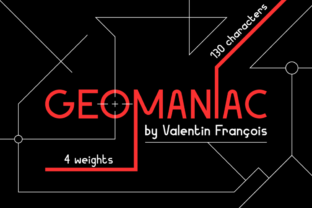
When evaluating typefaces for a project, the choice often comes down to how well a font balances visual character with practical readability. Geomaniac, designed by François Valentin, is a sans serif typeface that has garnered attention for its clean lines and measured elegance. Available in four distinct weights—Geomaniac Regular, Geomaniac Light, Geomaniac Bold, and Geomaniac Extra Light—it offers a modest yet versatile toolkit for designers working across digital and print media. This article provides an objective evaluation of Geomaniac, exploring its strengths, limitations, and the scenarios where it may serve well—or where alternatives might be a better fit.
What Is Geomaniac?
Geomaniac is a sans serif font family designed by French type designer François Valentin. The typeface is characterized by its geometric structure, moderate contrast, and smooth curves. Unlike purely geometric fonts such as Futura, which prioritize mathematical precision, Geomaniac incorporates subtle humanist touches that give it warmth without compromising clarity. The four weights—Extra Light, Light, Regular, and Bold—allow for a range of expression while maintaining a cohesive family identity. Valentin’s design aims to be both functional and refined, making Geomaniac suitable for projects that call for a clean, professional appearance without excessive ornamentation.
One of the first things to note about Geomaniac is its versatility within a limited weight range. While larger families offer dozens of weights and widths, Geomaniac’s four variants keep decision-making straightforward. This can be an advantage for designers who want consistency without the cognitive load of too many options. However, it also means the typeface may not cover every typographic need out of the box.
Why Consider Geomaniac?
Interest in Geomaniac typically arises from a need for a sans serif that is legible, elegant, and understated. Here are some common reasons designers evaluate this typeface:
- Clean aesthetics: The geometric yet slightly softened shapes make Geomaniac suitable for modern interfaces, branding, and editorial layouts where a neutral but polished look is desired.
- Weight flexibility: With Extra Light and Light, the font offers delicate options for large headlines or elegant display use, while Regular and Bold cover body text and emphasis.
- Designer pedigree: François Valentin has a reputation for careful craftsmanship, which gives the typeface a level of quality control that can be reassuring for professionals.
- Licensing clarity: Depending on the source, Geomaniac may be available under terms that suit both personal and commercial projects without hidden restrictions.
These factors make Geomaniac a candidate for projects where the typeface needs to support the content without dominating it. The font’s restraint can be a virtue in contexts where too much personality would compete with messaging.
Benefits and Strengths
Geomaniac offers several practical benefits that are worth considering in an evaluation:
- Readability at small sizes: The open counters and moderate x-height help maintain legibility in body text, especially in digital environments where screen resolution varies.
- Consistent color across weights: The family maintains a uniform texture from Extra Light to Bold, meaning you can mix weights without jarring visual shifts.
- Language support: Geomaniac includes accented characters and extended Latin coverage, making it usable for multilingual projects without additional font management.
- Pairing flexibility: Because Geomaniac is neutral but not cold, it pairs well with both serif and script typefaces, giving designers room to create contrast.
For example, a brand using Geomaniac Regular for body text and Geomaniac Light for headings can achieve a clean hierarchy without switching to a different family. This can simplify file management and reduce the number of font files needed.
Tradeoffs and Limitations
No typeface is without compromises, and Geomaniac has several that may influence your decision:
- Limited weight range: With only four weights, the family lacks true light and heavy extremes. For projects requiring a very thin hairline or a powerful black weight, you would need to supplement with another typeface.
- No italic or oblique: The Geomaniac family described here appears to include only upright roman styles. If you need italic emphasis or true italics for quotations, you may need to style manually or combine with another font.
- Less distinctive personality: The very neutrality that makes Geomaniac versatile can also make it forgettable in crowded visual environments. If your project needs a strong typographic voice, a more distinctive sans serif might serve better.
- License verification: As with any font, you should verify the specific license terms from the distributor. Some versions of Geomaniac may have restrictions on web usage, number of users, or embedding in apps.
These tradeoffs are not deal-breakers for many projects, but they do influence whether Geomaniac is the best choice versus another option. For a designer building a large design system, the lack of italics could be a significant gap. For a one-off presentation, it may be perfectly fine.
Where Geomaniac Performs Well
Based on its design characteristics, Geomaniac is a strong fit in the following situations:
- Minimalist branding: When a brand identity calls for a clean, modern sans serif that avoids trends, Geomaniac’s four weights provide enough range for logos, business cards, and letterhead without overwhelming the system.
- Editorial layouts with limited type needs: For magazines, reports, or brochures that require only a few weights and no italics, Geomaniac can handle both display and body text roles cohesively.
- User interface design: The font’s legibility at small sizes and its even texture make it a candidate for dashboards, mobile apps, and website UI where consistency across buttons, labels, and body copy is important.
- Personal projects and prototypes: For designers who want a solid sans serif without investing in a large font family, Geomaniac offers a professional look at a lower complexity level.
These use cases share a common thread: they benefit from a restrained typeface that does not require a full family ecosystem. If your project fits one of these scenarios, Geomaniac is worth testing.
When Alternatives May Be Better
In some situations, Geomaniac’s limitations suggest that another typeface may be a more practical choice:
- Extensive branding systems: If you are creating a brand with many touchpoints—print, web, signage, video—the absence of italic and limited weight range may force you to combine multiple typefaces, which introduces coordination risk. Families like Open Sans, Roboto, or Source Sans offer broader coverage.
- Academic or long-form publishing: For books, theses, or long articles that use italics for citations, foreign words, or emphasis, Geomaniac may require workarounds or pairing with a serif that has italics.
- Heavy display needs: If your project requires a very bold or ultra-light weight for dramatic effect, the four Geomaniac weights may not provide enough contrast. A larger family like Montserrat or Fira Sans offers more extremes.
- Designs requiring strong personality: For brands that need a distinct typographic voice—quirky, refined, or assertive—Geomaniac’s neutrality might feel too generic. More character-driven fonts like Work Sans or Nunito could be more memorable.
These alternatives share the design space with Geomaniac but include features that address specific limitations. The right choice depends on how much weight, italic, or personality your project actually needs.
Practical Decision-Making Insights
When evaluating Geomaniac for your own work, consider the following framework:
- Map your typographic needs: List the roles your typeface must perform—headings, body text, captions, emphasis—and check whether Geomaniac’s four weights cover those roles without relying on italics or additional families.
- Test in context: Download the font and test it at your actual usage sizes, screen resolutions, and printing conditions. A font that looks elegant in a specimen may behave differently in real-world use.
- Compare the license terms: Different distributors may offer Geomaniac under different licenses. Confirm that the license covers your use case—web font, desktop, app embedding—before committing.
- Assess pairing compatibility: If you decide to combine Geomaniac with another typeface, choose one with a complementary style. A serif like EB Garamond or Playfair Display can create a classic contrast, while a neutral sans like Lato might conflict visually.
- Evaluate long-term sustainability: If the project may expand or update over time, consider whether Geomaniac’s limited family will still serve you. A lack of italics or additional weights can become a constraint as needs evolve.
This approach helps you move from abstract evaluation to a concrete decision. Rather than asking “Is Geomaniac a good font?” the better question is “Is Geomaniac a good font for this specific project?”
Aligning Geomaniac With Your Goals
Choosing a typeface is ultimately a match between its design characteristics and the practical demands of your work. Geomaniac offers a clean, balanced sans serif with four reliable weights. It works well for projects where simplicity and clarity are paramount, and where the absence of italics or extreme weights is not a limitation. For designers who value ease of use and coherent family consistency, it presents a straightforward option without unnecessary complexity.
On the other hand, if your project requires a full typographic system with italics, more weight variation, or a more distinctive voice, you will likely need to look beyond Geomaniac. The same neutrality that makes it versatile also limits its expressive range. The key is to be honest about your project’s typographic demands before making a selection.
Ultimately, Geomaniac is a typeface that serves best when its constraints align with your needs. By approaching the decision with a clear understanding of what it offers—and what it does not—you can determine whether François Valentin’s design is the right tool for your next project.