Raising: A Handbrushed Font with a Rough Exterior for Distinctive Design Work
When a project calls for authenticity rather than polish, few typefaces deliver the raw character of a handbrushed font. Raising is one such option—a grungy, handcrafted typeface that comes in two variations: Raising Regular and Raising Italic. Designed to evoke the look of ink on paper with all its imperfections intact, this font offers a textured alternative to the clean vectors that dominate most digital libraries. But beyond its aesthetic appeal, does Raising hold up under real-world use? This article offers a practical evaluation of the font’s characteristics, strengths, and limitations, helping you decide whether it belongs in your toolkit.
What Is Raising? A Closer Look at the Typeface
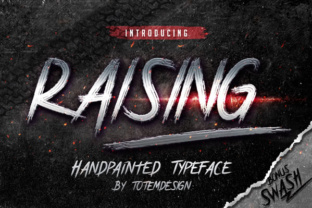
Raising is a display font built around the idea of deliberate imperfection. Its letterforms appear to have been drawn with a brush or marker on an uneven surface, resulting in irregular edges, variable stroke weights, and a gritty finish. Unlike many brushed fonts that smooth out irregularities, Raising leans into the rough texture, giving each character a slightly unpredictable quality. The typeface includes two styles: Raising Regular and Raising Italic. The italic variant adds a slant but keeps the same hand-drawn roughness, making it suitable for emphasis without losing the font’s core identity.
It is important to note that Raising is not a text font. Its high level of detail and texture makes it unsuitable for body copy, long paragraphs, or small sizes. Instead, it functions best as a display face—used for headlines, titles, logos, posters, and other large-format applications where its rough character can be fully appreciated. The font includes standard uppercase and lowercase letters, numerals, and basic punctuation, which is sufficient for most display needs but not extensive for multilingual or highly technical projects.
Genuine Roughness Rather Than Simulated Grit
Many grunge fonts rely on digital distortion or layering effects to create a worn appearance. Raising takes a different approach: its roughness appears organic, as though each letter was physically brushed onto paper. Strokes taper naturally, edges fray, and ink pools in certain areas. This authenticity gives the font a tactile quality that can be difficult to achieve with filters or post-processing. For designers working on projects that demand a handmade feel—such as craft branding, music posters, or independent publications—this characteristic is a clear advantage.
Two Styles with Distinct Roles
The Regular version of Raising provides a straight-ahead, upright stance that works well for primary headlines. The Italic version, while not a true cursive, introduces a forward lean that can be used for subheadings, callouts, or accent words. Because both styles share the same rough texture, they pair cohesively without clashing. However, the difference between them is not drastic; the italic is more a slanted version of the same basic form than a completely redrawn style. This means you gain consistency across both weights but lose some of the contrast that a fully distinct italic might offer.
Moderate Legibility at Display Sizes
Raising’s legibility is acceptable when used at large point sizes—typically 36 points or higher. The irregular strokes can make some characters harder to read at smaller sizes, especially letters like “a,” “e,” and “s,” which rely on fine details. For short words or single lines, this is rarely an issue. For longer headlines or multi-word phrases, you may need to adjust tracking or letter-spacing to avoid crowding. The font’s x-height is moderate, and its overall proportions are relatively even, which helps maintain readability despite the grunge.
Strengths in Branding and Identity Work
For small businesses, creative studios, or solo entrepreneurs looking to establish a rugged or artisanal identity, Raising offers immediate visual character. A coffee roaster, a handmade soap company, or a local music venue might use this font on packaging, signage, or social media graphics. The rough texture communicates hands-on effort and authenticity—qualities that resonate with audiences tired of overly polished corporate design. When paired with clean sans-serif fonts for body text, Raising can anchor a brand identity that feels both grounded and distinctive.
Effective Use in Posters, Flyers, and Event Materials
Printed materials benefit greatly from the tactile appearance of Raising. Posters for concerts, festivals, art exhibits, or workshops can use the font to create a sense of immediacy and raw energy. The irregular strokes catch light differently than smooth vector fonts, giving printed pieces a slightly dimensional look. On digital screens, the roughness translates well as long as the font size remains generous. For social media graphics or web banners, Raising can serve as a hero element, but it should be used sparingly to avoid visual fatigue.
Limitations in Digital and Small-Scale Applications
Raising is not ideal for body text, small buttons, captions, or any context where legibility at small sizes is critical. Its rough edges can become muddled when rendered below 24 points, especially on lower-resolution screens. Additionally, the font lacks extensive language support or advanced typographic features such as ligatures, alternates, or stylistic sets. This limits its use in multilingual projects or designs that require nuanced typographic control. For users who need a grunge font with more flexibility, a larger family with multiple weights or OpenType features might be a better fit.
Installation and Compatibility
Raising is available in standard font formats (typically OTF or TTF) and works with most major design software, including Adobe Creative Suite, Affinity products, and web design tools. Installation is straightforward on both macOS and Windows. No special licensing restrictions apply for most commercial projects, but you should always verify the license terms with the distributor. For web use, the font may need to be converted to web font formats or hosted via a service that supports custom typefaces.
Pairing Recommendations
Because Raising carries significant visual weight and texture, it pairs best with simple, neutral fonts. Sans-serif typefaces like Helvetica, Open Sans, or Montserrat create a balanced contrast. Serif fonts can work if they are understated, but avoid pairing Raising with another grunge or highly decorative font, as the result can become chaotic. For printed materials, consider using a heavier sans-serif for secondary information to match the bold presence of Raising. In digital contexts, lighter weights help maintain hierarchy without competing for attention.
Testing and Iteration Advice
Before committing Raising to a final project, run it through several real-world tests. Print a sample at the intended output size—especially important if you are designing for large posters or signage. Check the font at various scales on both screen and paper. Adjust tracking and kerning manually if needed, as some character pairs may require fine-tuning due to the irregular shapes. If the font will appear in multiple contexts (e.g., web and print), verify that its appearance remains consistent across platforms.
Who Benefits Most from Using Raising?
Based on its characteristics, Raising is best suited for specific user groups and scenarios.
- Freelance designers and creative studios working on branding projects for clients in the food, beverage, music, or arts sectors will find that Raising adds an immediate handmade quality that fits those industries.
- Small business owners and entrepreneurs managing their own marketing materials can use Raising for logo ideas, social media graphics, or flyers without needing extensive design experience—though some familiarity with typography is helpful.
- Educators and workshop facilitators creating posters, handouts, or title slides can leverage the font’s rough aesthetic to signal a creative or informal learning environment.
- Marketers and publishers producing limited-run publications, zines, or event programs may appreciate the font’s ability to break away from standard corporate typefaces.
- Serious hobbyists engaged in personal projects such as album art, merchandise designs, or journal covers will find Raising a reliable tool for adding texture and personality.
On the other hand, Raising may not suit corporate identities that require a clean or professional appearance, nor is it appropriate for legal documents, financial materials, or any context where strict legibility and neutrality are paramount. Its grunge character is a deliberate choice and should be used with intentionality.
Long-Term Value and Effectiveness
Fonts like Raising tend to hold their value as long as their aesthetic remains relevant. Handcrafted, rough typefaces have shown staying power in the design world because they offer a counterpoint to the increasing homogeneity of digital design. However, Raising’s limited variation (only two styles) may cause it to feel repetitive after heavy use. Designers who frequently change visual directions may find that the font suits only a narrow range of projects. For those who specialize in grunge or handmade aesthetics, Raising can become a consistent workhorse, but it should be supplemented with other typefaces to avoid overuse.
In terms of effectiveness, Raising performs well when used as a focal point. It commands attention and communicates a specific tone better than many neutral fonts. If your goal is to create a design that feels immediate, physical, and unpolished in a deliberate way, Raising delivers. If your goal is versatility or mass appeal, other options may serve you better. Knowing where and when to apply this font is the key to extracting its full value.
Final Observations on Raising Regular and Italic
Raising stands as a solid choice within the niche of handbrushed, grunge display fonts. Its two-variation set offers just enough flexibility for headlines and emphasis while maintaining a consistent rough texture. The font excels in contexts where authenticity, craft, and raw visual energy are assets. Its limitations—small size legibility, lack of extensive features, and narrow application range—are not drawbacks but rather defining parameters. For the right audience and the right project, Raising can be a distinctive and effective tool. Assess your specific needs, test the font in your own workflow, and decide whether its rough exterior aligns with the message you want to convey.