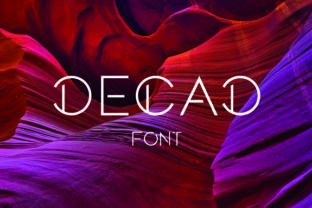
Decad: A Clean Font with a Modern Twist for Contemporary Design
In the ever-evolving landscape of typography, few names capture the balance between clarity and personality as precisely as Decad. This clean font with a modern twist has steadily gained traction among designers, developers, and brand strategists who seek a typeface that feels both timeless and fresh. Decad does not shout for attention; instead, it speaks through the deliberate geometry of its letterforms, the subtle curves that soften its edges, and the generous spacing that invites readability. For professionals ranging from UI/UX designers to editorial art directors, understanding when and how to use Decad can elevate a project from merely functional to distinctly memorable.
The Design Philosophy Behind Decad
At its core, Decad embodies a philosophy that prioritizes legibility without sacrificing aesthetic nuance. The typeface belongs to the modern sans-serif family, yet it avoids the sterility that often plagues minimal designs. Each character in Decad has been crafted with a dual purpose: to remain neutral enough for long reading sessions and to introduce just enough flair to keep the eye engaged. The designers behind Decad understood that a clean font does not have to be boring; the modern twist comes from slight asymmetries in terminals, subtle variations in stroke width, and the thoughtful handling of junctions where curves meet straight lines.
Geometric Precision with a Human Touch
One of the most striking characteristics of Decad is its geometric foundation. The circles are round, the rectangles are square, and the diagonals align with mathematical precision. Yet Decad avoids the coldness of pure geometry by incorporating humane details. For instance, the lowercase 'a' features a small tail that curves gently outward, reminiscent of handwriting, while the uppercase 'R' has a leg that extends with a slight flourish. These touches make Decad approachable in corporate brochures, welcoming on personal blogs, and authoritative in academic papers. The x-height is generous, which improves readability at smaller sizes, and the counters—the enclosed spaces in letters like 'e' or 'a'—are open enough to prevent crowding even in dense paragraphs.
Where Decad Excels: Primary Use Cases
Decad’s versatility stems from its ability to adapt across media without losing its core identity. Whether it’s a digital interface, a printed poster, or a branding system, the font maintains consistent character. Below are the primary domains where Decad has proven most effective.
Branding and Identity
For brands that want to communicate innovation and reliability, Decad serves as a neutral-yet-distinctive voice. Tech startups often choose Decad for their logotypes and website headers because it conveys forward thinking without appearing aggressive. A fintech company, for example, might pair Decad Light for body text and Decad Bold for call‑to‑action buttons, creating a hierarchy that feels both trustworthy and dynamic. In the fashion industry, Decad’s clean lines complement minimalist branding, allowing product imagery to take center stage while the typography quietly reinforces the brand’s modern ethos. One observation from real‑world use is that Decad works exceptionally well in monochrome settings; a black‑and‑white logo using Decad retains all its nuance, proving its value in print applications like business cards and stationery.
Digital Interfaces and Web Design
On screens, where legibility can make or break user experience, Decad shines because of its deliberate spacing and clear differentiation between similar characters. The font includes distinct shapes for uppercase ‘I’, lowercase ‘l’, and numeral ‘1’, eliminating common confusions. Web designers appreciate that Decad loads efficiently and renders consistently across browsers, even at small sizes. In UI kits, Decad is frequently used for navigation menus, headings, and form labels. Its modern twist—a slight slant in the uppercase ‘Q’ or the unique crossbar on the ‘f’—adds a touch of personality to interfaces that might otherwise feel sterile. For long‑form content on devices, Decad’s generous x-height reduces eye strain, making it a practical choice for news apps and educational platforms.
Print and Editorial Applications
While Decad is undeniably digital‑friendly, it also performs admirably in print. Magazines that aim for a clean, contemporary look often select Decad for pull quotes and subheadings. The font’s medium weight ink well without spreading, even on uncoated paper. In brochures and white papers, Decad provides a consistent voice across sections, while its light weight can be used for captions and footnotes. A notable use case is in art catalogs: the contrast between Decad’s geometric shapes and organic visual art creates an interesting tension that draws the reader’s attention to both. Printers have observed that Decad’s kerning tables are well‑optimized, reducing the need for manual letter‑spacing adjustments in layout software.
Practical Considerations for Designers
To leverage Decad effectively, designers should understand its technical characteristics and how it interacts with other elements. The font is available in multiple weights—typically Light, Regular, Medium, Bold, and Black—each with corresponding italics. This range allows for expressive typographic hierarchies without resorting to multiple type families.
Choosing the Right Weight for Your Project
The weight selection should mirror the intended tone. Light and Regular weights work best for body text and data‑heavy layouts where clarity is paramount. Medium and Bold weights excel in headings and short phrases meant to grab attention. Black weight, with its increased stroke contrast, is ideal for impactful posters or hero sections on landing pages. However, designers should avoid using Black for small text, as the counters may close up at reduced sizes. A practical tip: test Decad at the actual output size before committing, as the font’s subtle details become more apparent in larger headings.
Combining Decad with Serif or Script Fonts
Because Decad is a clean sans‑serif, it pairs beautifully with a classic serif for editorial content. For instance, using a serif like Merriweather for the body and Decad for headings creates a rhythm that is both readable and aesthetically pleasing. The modern twist in Decad complements script fonts as well, particularly in wedding invitations or lifestyle branding where a handwritten accent is desired. The key is contrast: Decad’s geometric purity provides a stable anchor against more ornate styles. Avoid pairing Decad with another neutral sans‑serif, as the similarity may cause visual monotony.
The Future of Modern Typography: Where Decad Fits
As design trends shift toward authenticity and accessibility, fonts like Decad are becoming essential tools. The clean lines align with the growing preference for minimal interfaces, while the modern twist satisfies the need for brand differentiation. Designers are also exploring variable font versions of Decad, which would allow dynamic weight adjustments in web environments—a development that could further cement Decad’s role in responsive design. Crucially, Decad’s open counters and balanced proportions ensure it meets accessibility standards, making it a responsible choice for inclusive design.
Educators teaching typography have begun including Decad in their curriculum to illustrate how a font can be simultaneously neutral and characterful. Students observe that Decad does not call attention to itself; rather, it services the content while adding a subtle layer of sophistication. This self‑effacing quality is perhaps the font’s strongest advantage—it does not outshine the message but ensures the message is delivered with elegance.
Hobbyists and small business owners, too, have adopted Decad for side projects and personal brands. The font is often available through creative marketplaces with licensing that suits both commercial and personal use. For someone launching a blog on a tight budget, Decad provides a professional look without the cost of a high‑end custom typeface. The community surrounding Decad is active, with forums sharing pairing suggestions and CSS implementation tips, which further lowers the barrier for non‑designers.
Ultimately, Decad exemplifies how a typographic tool can serve multiple masters—the strict demands of usability, the subjective realm of aesthetics, and the practical constraints of budget and performance. Its clean foundation and modern twist allow it to navigate these realms without compromise. Whether you are a researcher presenting findings, a creator building a digital product, or a business owner establishing a visual identity, Decad offers a reliable voice that is both clear and captivating. As digital and print boundaries continue to blur, having a font that works seamlessly across mediums is not just a convenience; it is a strategic advantage.
The ongoing evolution of Decad suggests that its designers understand the need for continuous improvement. Regular updates to the character set, inclusion of ligatures, and optimizations for screen rendering keep the font relevant. Users report that newer versions handle special characters, such as accented letters and mathematical symbols, with the same grace as the core alphabet. This attention to detail makes Decad a trustworthy companion for global projects requiring multilingual support.
In a world where first impressions are increasingly visual, the choice of typeface can either reinforce or undermine a message. Decad, with its clean lines and modern sensibility, offers a safe yet stylish choice. It invites readers to stay, to read, and to trust the content. And that, ultimately, is the highest purpose any font can achieve.