The Personal Touch of Dylan: How a Handwritten Font Captures Authentic Expression
In an era of sterile, uniform typography, the resurgence of handwritten fonts signals a collective hunger for authenticity. Among these, Dylan stands apart—not merely as a typeface but as a direct artifact of human gesture. Created by Dylan Culhane, the font began as an intimate act of self-documentation and evolved into a versatile tool for designers, educators, and creators who crave warmth in their visual communication. Understanding what makes Dylan distinctive requires looking beyond its aesthetic appeal to the philosophy embedded in its uneven curves and deliberate imperfections.
The Origins of Dylan as a Design Artifact
Dylan Culhane did not set out to create a commercial font. The letterforms that would become Dylan started as personal notes, sketches, and reflective writing. This origin story matters because it shapes the font's character. Unlike fonts designed purely for legibility or scalability, Dylan retains the idiosyncrasies of an individual hand—the varying pressure, the slight tilt in certain letters, the way lowercase 'g' loops back with a particular flair. These details are not flaws; they are signatures of humanness.
When Culhane decided to digitize his handwriting, he faced a critical choice: smooth out the inconsistencies for mass appeal or preserve the raw authenticity. He chose the latter. The result is a typeface that feels familiar yet unpredictable, much like receiving a handwritten letter in a world of printed bills. This decision aligns with a broader shift in design culture toward embracing imperfection as a form of honesty.
Decoding the Visual DNA of Dylan
At first glance, Dylan appears casual, almost effortless. But a closer examination reveals deliberate structural choices that set it apart from other handwritten fonts.
Stroke Variation and Rhythm
Most handwritten fonts rely on consistent stroke thickness, which can feel mechanical. Dylan exhibits natural variation: ascenders that taper slightly, descenders that carry momentum, and letters that connect with visible pen lifts. This creates a reading rhythm that mimics natural handwriting rather than typographic precision. For long-form reading, this rhythmic quality reduces eye strain because the brain processes it as familiar handwritten text rather than cold print.
Letterform Personality
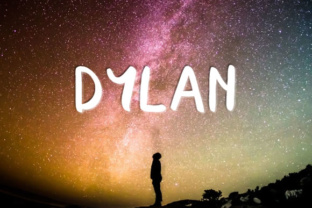
Each character in Dylan carries personality. The uppercase 'D' opens wide with a confident curve, while the lowercase 'a' retains an open counter that improves readability at small sizes. The descender on 'y' and 'g' sweeps downward with a consistent angle, creating visual flow across lines. These details matter when the font is used in branding or headlines, where individual letters become focal points.
Spacing and Kerning Considerations
Culhane designed Dylan with generous default spacing that prevents the letters from feeling cramped, a common issue with digitized handwriting. The kerning pairs—such as 'V' and 'A' or 'r' and 'n'—are tuned to avoid awkward collisions while preserving the organic look. This attention to spacing means Dylan performs well in both short phrases and longer passages, a versatility not all handwritten fonts achieve.
Real-World Applications of Dylan Across Audiences
The utility of Dylan extends far beyond its aesthetic charm. Its application depends on context, audience, and medium.
Branding and Identity Design
Small businesses and creative entrepreneurs often struggle to convey personality through logos. Dylan offers a solution: a custom-feel typeface that implies craftsmanship and personal attention. A bakery using Dylan for its signage signals artisanal quality. A boutique consultancy employing Dylan in its pitch decks suggests a human-centered approach. The font works particularly well when paired with a sans-serif such as Open Sans or Lato, creating contrast between the personal and the professional.
Educational Materials and Classroom Use
Teachers and educators have adopted Dylan for worksheets, bulletin boards, and digital lesson materials. The font's natural rhythm helps young readers transition from block letters to cursive without intimidation. Its clear letterforms reduce confusion between commonly mistaken characters like 'b' and 'd' or 'p' and 'q'. Additionally, Dylan's handwritten quality makes printed materials feel less institutional and more inviting, which can increase student engagement.
Content Creation and Social Media
Content creators, particularly those on platforms like Instagram and Pinterest, use Dylan to add a personal touch to quotes, announcements, and storytelling posts. The font pairs well with imagery because it doesn't compete for attention—it complements. A food blogger might use Dylan for recipe titles, while a travel writer might employ it for location captions. The key advantage is recognizability without overbearing uniqueness.
Personal Projects and Correspondence
In an age of digital communication, Dylan serves as a bridge to intentionality. Invitations, thank-you notes, and personal websites benefit from its warmth. Couples planning weddings have used Dylan for stationery because it evokes the intimacy of handwritten invitations without the legibility issues of actual handwriting. The font becomes a tool for emotional resonance, not just information delivery.
Advantages of Choosing Dylan Over Other Handwritten Fonts
The market for handwritten fonts is crowded, but Dylan occupies a distinct position. Understanding its advantages helps designers make informed choices.
Legibility at Scale
Many handwritten fonts degrade at small sizes or become distracting when used in blocks. Dylan maintains clarity at 12pt body text and scales gracefully up to 72pt for headlines. This scalability stems from Culhane's careful digitization process, which preserved open counters and distinct letter shapes without excessive flourishes.
Neutral Personality
Some handwritten fonts lean heavily into a specific mood—whimsical, grunge, or elegant. Dylan sits in a neutral zone that adapts to context. It can appear professional in a business report yet playful in a children's book. This versatility reduces the need for multiple fonts within a project and simplifies design workflows.
Cross-Platform Reliability
Dylan renders consistently across operating systems and browsers, a critical factor for web designers. Its inclusion in font libraries means developers can implement it without worrying about fallback failures. This reliability makes it a safe choice for production environments where typography cannot afford surprises.
Practical Considerations for Implementing Dylan
Even a well-designed font requires thoughtful implementation. Here are considerations that affect Dylan's performance in real projects.
Screen vs. Print Behavior
On high-resolution screens, Dylan's stroke variation renders beautifully thanks to modern display technology. However, on lower-resolution screens or small sizes, the thinner strokes may appear faint. Designers should test Dylan at intended sizes and consider slight font-weight adjustments for digital use. In print, the font shines across standard paper stocks, though uncoated papers may cause ink spread that thickens the thinner strokes.
Language and Character Support
While Dylan includes standard Latin characters and common punctuation, users working with extended character sets or non-Latin scripts should verify coverage. Culhane has expanded the character set over time, but specialized projects may require supplementary fonts. For multilingual designs, pairing Dylan with a comprehensive sans-serif ensures consistency across languages.
Licensing and Usage Rights
Dylan is available under various licensing models, including personal, commercial, and web licenses. Designers should review the specific terms before using the font in products or digital platforms. The font's popularity has led to widespread availability, but respecting the creator's work ensures continued development and support.
Dylan in the Context of Typography Trends
Handwritten fonts have cycled in and out of fashion, but Dylan's staying power reflects a deeper shift in design philosophy. The current trend toward design that feels human has elevated fonts that carry evidence of a hand at work. Dylan sits at the intersection of several movements:
- Authenticity over perfection: Audiences increasingly value realness over polish. Dylan's visible imperfections signal honesty.
- Personalization at scale: Brands want to feel individual without sacrificing consistency. Dylan provides a custom-like appearance with professional reliability.
- Nostalgia without sentimentality: Handwriting evokes memory, but Dylan avoids overt retro stylings. It feels timeless rather than dated.
These trends suggest that Dylan is not a passing novelty but part of a larger recalibration of what typography communicates.
Observations from Practitioners Who Use Dylan
Designers and educators who regularly use Dylan report specific behaviors worth noting. A graphic designer noted that clients often respond to Dylan-heavy layouts with comments like "it feels personal" or "it looks like you made an effort." This emotional resonance translates to perceived value. A teacher observed that students were more willing to read worksheets set in Dylan compared to standard fonts, suggesting the format influences motivation.
These observations point to a broader truth: font choice is never neutral. Every typeface carries associations, and Dylan's associations lean toward care, effort, and human connection. In professional contexts, these associations can be leveraged intentionally.
Comparing Dylan to Digital Counterparts
Understanding Dylan also means understanding what it is not. Standard digital fonts like Arial or Times New Roman prioritize uniformity and efficiency. They are designed to disappear, to let content speak without typographic interference. Dylan, by contrast, demands attention—not aggressively, but persistently. It asks the reader to acknowledge that someone wrote this. This shift from reading content to reading a person's hand changes the relationship between author and audience.
Furthermore, Dylan differs from calligraphy-based fonts, which often emphasize ornamental beauty over everyday utility. Dylan's strength lies in its everydayness. It looks like someone's regular handwriting, not a formal script designed for certificates and diplomas. This grounded quality makes it accessible for projects where elegance would feel out of place.
Final Reflections on Dylan as a Design Tool
Dylan is more than a font; it is a creative choice that communicates intent. When a designer selects Dylan, they signal a willingness to prioritize warmth over sterility, personality over anonymity. For Dylan Culhane, transforming his personal handwriting into a publicly available typeface was an act of vulnerability and generosity. The font carries that spirit forward every time it is used.
For professionals seeking to improve engagement, educators wanting to reduce distance in their materials, or anyone who believes that communication should feel human, Dylan offers a practical path. It is not a solution to every design problem, but it is a reminder that sometimes the most powerful tool is the one that looks like it came from a person rather than a machine.
The next time you select a typeface, consider what you want readers to feel before they even read a word. If the answer includes connection, trust, or warmth, Dylan deserves a place in your toolkit. Its letters carry more than meaning; they carry a trace of the hand that shaped them.